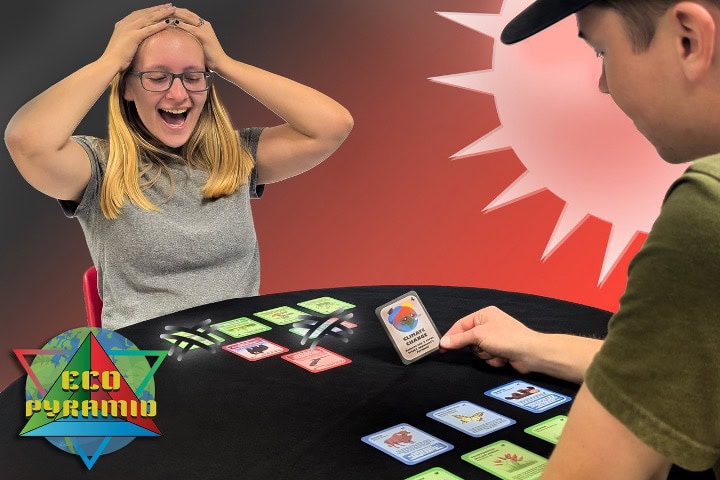
An educational game created by McPherson College students to help children explore ecosystems is getting statewide, and soon national, attention. A grant of $10,000 from the Kansas Department of Wildlife and Parks’ Chickadee Check-Off program will fund efforts to bring the game to every school district in Kansas as students begin to raise funds for national distribution.
Students in the spring 2025 Stewardship Seminar, taught by Dr. Dustin Wilgers, professor of biology, developed the game EcoPyramid, which is based on a visual model representing the structure of an ecosystem. Each level of the pyramid represents different components essential to maintaining a healthy environment.
“Once the class decided on a topic and the idea for the game, it snowballed from there,” Wilgers said. “The students were really excited to get to class and discuss how the game would be played.”
Six students spent about a month developing the game, drawing inspiration from a variety of popular card games. Players use their own deck of cards to build a trophic pyramid while disrupting their opponents’ pyramids with unique action cards. Designed for two to four players, the interactive, fast-paced card game aims to be both fun and educational.
“The students really homed in on the idea of community ecology topics that are fun but important in understanding how ecosystems and communities are structured,” Wilgers said. “We ended up coming up with the idea of building a pyramid where each action connects the levels of the pyramid. We integrated real-world impacts on ecosystems with cards representing things that cause ecosystems to crumble and things that build them up and protect them.”
The first deck developed represented the Yellowstone ecosystem. Eventually, there will be four decks based on different environments. Players can choose any deck and build an ecosystem using their own cards. Students spent hours refining the wording, art concepts, and testing the game. A student from the graphic design department helped finalize the artwork for each deck, and students in the teacher education program assisted with classroom testing.
In addition to testing the game in a local elementary school, the students showcased EcoPyramid at a campus gaming event last spring, a children’s summer program at the Hutchinson Zoo, and received feedback from the gamification department at Kansas State University.
The project has extended far beyond the original class. Students have spent hundreds of hours testing and refining their idea, continuing to work on it through the summer and into the fall semester.
“While I was a camp counselor this summer, I tested the game with third through fifth graders who loved it,” said Amanda Goering, one of the students continuing to develop the game. “I’m still working on EcoPyramid because I was inspired by them to create a game that is fun and educational. I hope someday the game is in every classroom across the U.S.”
A Horizon Fund grant from McPherson College supported the initial work, and the Chickadee Checkoff grant will fund the printing of 750 decks for distribution to the Kansas Department of Wildlife and Parks and to Kansas school districts. The students and Wilgers plan to launch a Kickstarter campaign to fund printing additional decks for a national audience.