Graduation
138th McPherson College Commencement Ceremony
Saturday, May 9, 2026
9:00 am | McPherson Stadium
Program
PRELUDE
Brass Quintet Mr. Trae Gehring-tuba, Mr. Eric Goering-trombone, Dr. Isaac Hopkins-trumpet, Prof. Kyle Hopkins-horn, Dr. Kirk MacGregor-trumpet
Amparito Roca by Jaime Texidor Dalmau
Canzona Prima a 5 by Giovanni Gabrieli/arr. Arnold Fromme
Sonata from Die Bänkelsängerlieder by anonymous/arr. Robert King
March from Second Suite in F by Gustav Holst/arr. Jerry Nowak
PROCESSIONAL
Bagpipes Mr. Lonny Liljegren, Mr. Gavin Frazier, Mr. Ben Mourn
Traditional Scottish Bagpipe Tunes
INVOCATION
Dr. Aaron Meis, Executive Vice President
WELCOME
Ms. Kenya McCain, Senior Class Representative
COMMENCEMENT ADDRESS
Prof. Michaela Groeblacher, Professor of Art
“The Transformative Power of Clay: Lessons for Everyday Life”
PRESENTATION OF CANDIDATES
Dr. Matthew Skillen, Vice President for Academic Affairs
CONFERRING OF DEGREES AND HONORS
Dr. Michael Schneider, President
Dr. Matthew Skillen
BENEDICTION
Dr. Aaron Meis
RECESSIONAL
Brass Quintet
Triumphal March from Aida by Giuseppe Verdi/arr. Bill Holcombe
Michaela Groeblacher
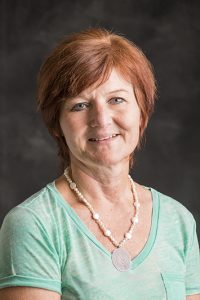
Born and raised in Austria as a people- and nature-loving, artistic child, Michaela worked as a physical therapist for ten years, before she and her husband and daughter emigrated to the USA in 1989, arriving first in McPherson, Kansas. They later moved to the Pacific Northwest, where she found that landscape design combined her love for art and nature, and she earned a degree that led her to plan and oversee the installation of many gardens in and around Seattle, WA. In 2000, moving back to Kansas challenged her creativity yet again. Influenced by the wide-open spaces, the closeness to land and earth, and encouraged by an artist friend who introduced her to clay as an artistic medium, Michaela began sculpting in clay, which led her to receive a BA in fine arts from McPherson College in 2005. During art classes her childhood love for painting re-awakened, and she started dividing her creative time between working in clay and painting. Eventually she found a way to combine both media and her knowledge as a therapist in her “Clay People” sculptures, many of which were derived from her experience as sculptor-in-residence in a Kansas nursing home (Bethany Home in Lindsborg). In 2014 she graduated with a Master of Fine Arts degree from Fort Hays State University, specializing in figurative ceramic sculpture. She has been a member of the art faculty at McPherson College for 14 years and resides in Lindsborg.
Her art work is exhibited nationally and internationally and has received many awards. It is part of private, corporate, and museum collections in the USA and Europe, has been featured on TV, and is published in ceramics magazines and art books.
Schedule of Activities
Monday, April 27
10:00 a.m. – 3:00 p.m. Senior Fest in Friendship Hall
All graduating seniors are required to attend Senior Fest to receive their caps and gowns, ensure they have filled out all necessary forms and surveys, and receive their student athlete and leadership stoles, senior SGA gift, and MC Alumni gift!
To receive your cap and gown, your bill must be paid, including the last payment for a payment plan. Any seniors who are student teaching and unable to attend can reach out to the Registrar’s Office at [email protected] to arrange to pick up your items during business hours before graduation.
Thursday, May 7
1:00 p.m. Class Group Photo at Harnly Garden
All bachelor’s degree students should report to Harnly Garden (in front of Melhorn Hall) at 1:00 p.m. in cap and gown. Please be on time so you do not miss being a part of the group photo. You will receive a link to your free group photo in a future email.
Following Class Photo Commencement Rehearsal for All Graduates
Immediately following the group photos, we will rehearse for the Saturday ceremony. Note: You must attend rehearsal if you plan to participate in Commencement.
Saturday, May 9
8:30 a.m. Line Up for Commencement Processional
We will gather inside Holman Fieldhouse to line up for the processional. Students line up alphabetically by last name in the large gym. Faculty and staff in the small gym. The platform party, faculty, staff and graduates will process in that order from the Fieldhouse to seating on the track.
9:00 a.m. Commencement Ceremony
So that you and your family need not worry about capturing the moment, a professional photographer will take photos of all graduates as they receive their diploma cover. You will receive a link to access your free photo in a later email. The ceremony will also be streamed on this page.
After the Ceremony
The recessional will conclude in front of Miller Library. You, your family, and friends are welcome to linger on campus and take casual photos.
The Boiler House
Will be open on Friday and Saturday for families on campus for graduation.
Additional Info
To order class rings and commencement invites, please visit www.cbgrad.balfour.com.
Graduates’ guests will not need tickets for admission to the stadium. However, lightning, strong storms, or disruptive conditions such as the high winds could still drive the Commencement ceremony indoors to Brown Auditorium. Because tickets will be required for selected guests to gain admittance to Brown Auditorium, graduates will receive tickets, which will be sent to their Bulldog email address.
Important Reminder! You are eligible to participate in the Commencement ceremony provided you meet all the following conditions:
- Your financial balance is paid in full.
- You have completed the Career Services outcomes survey.
- You meet the following academic criteria:
- You have six or fewer credits remaining to complete your degree.
- You have a minimum GPA of 2.0 or higher in both your major and your cumulative residential coursework.
- If you are an elementary education major, you have completed your student teaching.
- If you are seeking secondary teaching licensure, you have completed your major content requirements.
Should you have additional questions about the above conditions or about the Commencement rehearsal or ceremony, do not hesitate to contact the registrar’s office at [email protected].
Past ceremonies: